
Check-ups in Vienna 1010
Prevention that truly prevents.
Most check-ups detect diseases early. That is good, but I would prefer that they never develop in the first place. With colonoscopy, this has long been our approach: we remove precancerous lesions before cancer develops. So why not do the same for blood sugar, the blood vessels and the liver?
That is why we take a close look, with laboratory tests, ECG and ultrasound, and then discuss at leisure what you should work on and what you can safely leave aside.

What we examine
More than “values within the normal range”
A laboratory value within the normal range does not necessarily mean that everything is working optimally. What interests me is the direction things are heading, and where we can still intervene now.
Heart and blood vessels
Blood pressure, ECG and ultrasound of the carotid arteries show the condition of your blood vessels. With blood lipids, I look not only at LDL but also at ApoB. And lipoprotein(a) should be measured once in a lifetime: it is largely genetically determined and increases the risk of heart attack, even when everything else is in order.
Glucose metabolism
An HbA1c of 6.0% is often still regarded as unremarkable. In fact, it already lies within the prediabetes range: average blood glucose is already elevated. Insulin sensitivity often declines years before blood glucose becomes abnormal, and that is precisely when the most can be achieved.
Liver and abdominal organs
On ultrasound, I examine the liver, gallbladder, pancreas, kidneys and abdominal aorta. Fatty liver is common, causes no symptoms for a long time and responds well to intervention once it has been identified.
Thyroid
Ultrasound and laboratory values. Nodules and functional disorders are common and often go unnoticed for a long time because the symptoms are so non-specific: fatigue, weight, mood, digestion.
Bowel cancer screening
Colonoscopy is one of the few screening examinations that can prevent cancer, because precancerous lesions are removed during the examination itself. From the age of 45, earlier if there is bowel cancer in the family. I perform it myself, under deep sedation.
Muscle and body composition
Muscle mass is one of the best predictors of healthy ageing. On request, bioimpedance analysis shows how much muscle, fat and water your body contains, allowing us to track changes over time.
Which laboratory values are appropriate depends on your medical history and your risk. You can find more about colonoscopy on the page Gastroscopy and colonoscopy.
How health is created
Five pillars we can work on
Some people remain healthy for a long time despite smoking, little exercise and a poor diet. That is why it is worth asking not only how diseases develop, but also how health is created and maintained.
Genetics
This we cannot change. But those who know their risk, such as a high lipoprotein(a), can take countermeasures early.
Nutrition
The body can only function and regenerate well if it receives the right building blocks. And people respond very differently to the same meal.
Exercise
The medicine that outperforms many actual medicines. And the best insurance for your muscles in later life.
Stress and emotional health
Through cortisol, chronic stress alters almost everything we aim to improve: blood sugar, blood lipids, sleep, muscle building, fat distribution.
Sleep
During deep sleep, the brain clears itself. And after a poor night, blood glucose is measurably higher the following day.
Procedure and costs
Two ways to a check-up
The basic check-up is a thorough overview in a single appointment. The health check is more comprehensive: more time, additional measurements and a written report that you receive at the end of the appointment.
For regular check-ups
Basic check-up
About 60 minutes
A thorough overview in a single appointment. You come fasting, everything takes place during the same visit, and we discuss the results already available straight away.
- Detailed consultation and physical examination
- Blood tests during the appointment
- ECG
- Ultrasound of the abdomen, thyroid and carotid arteries
- Laboratory results with a brief interpretation via Mein Arzt Online
New from January 2027
Comprehensive internal medicine health check
About 90 minutes
For a comprehensive assessment of where you stand. As blood is taken one week beforehand, all results are available during the appointment, and you receive the written report at its conclusion.
- Everything included in the basic check-up
- Blood tests one week beforehand, with an extended cardiovascular risk profile
- Grip strength and body composition (BIA)
- Written report: the three most important points first, every value with its interpretation
- Personal prevention plan for the years ahead
Available as an addition to either option, for instance before returning to sport or in the presence of risk factors.
Available as an addition to the basic check-up: muscle mass, body fat and water. Included in the health check.
Where clinically indicated, laboratory costs are usually covered by your statutory health insurer; any values it does not cover are discussed in advance. As a private physician (Wahlärztin), I bill privately; you can submit the invoice to your statutory health insurer. All services and prices can be found under Services.
Health check
What your report looks like
At the end of the health check, you receive a written report. It begins with the three points that matter most over the coming months.
Every value then follows with its interpretation: where the clinical threshold lies, where your personal target is and what it is based on. A prevention plan shows which examination is due when, and a separate section records what we deliberately did not examine, and why.
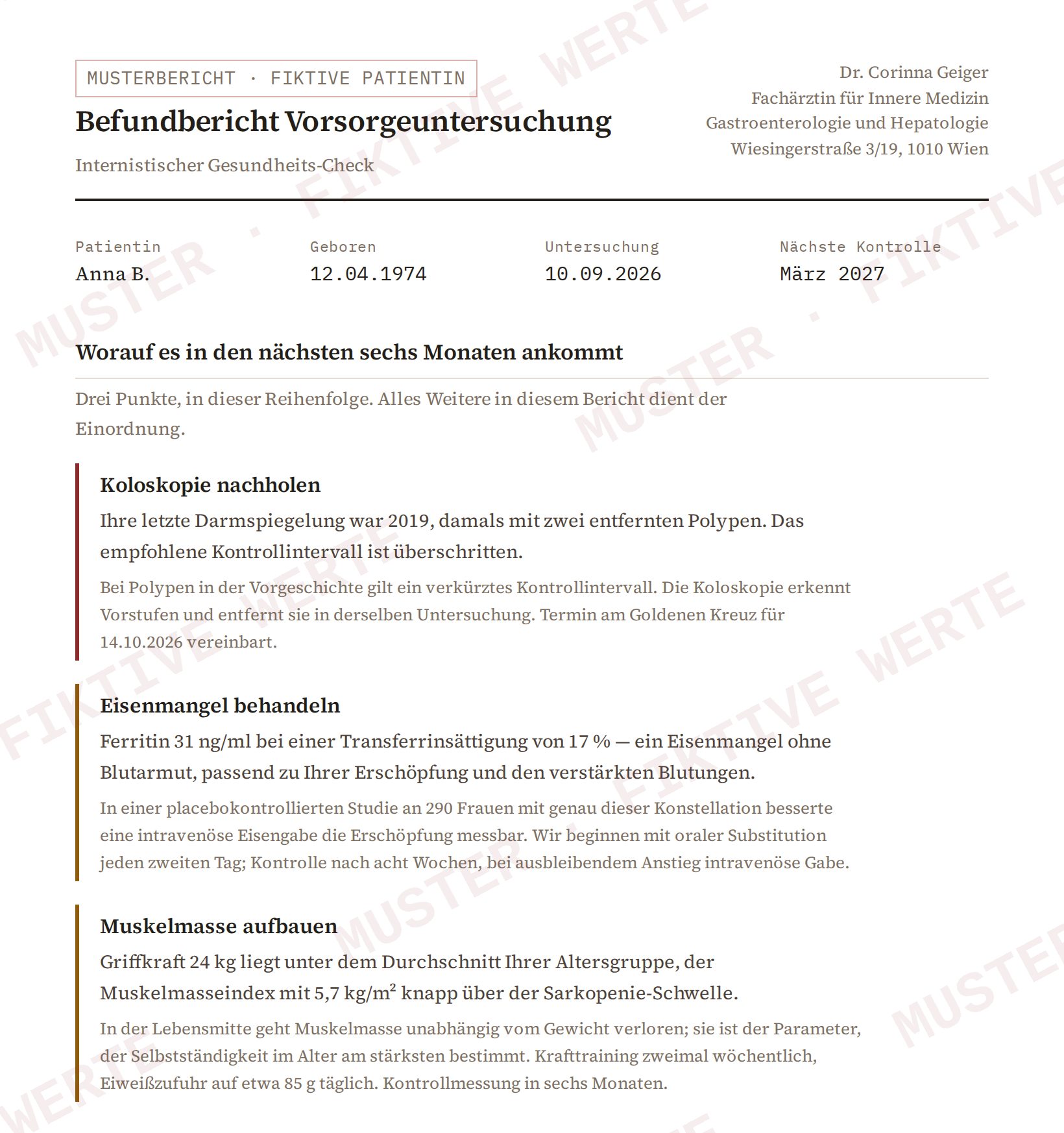
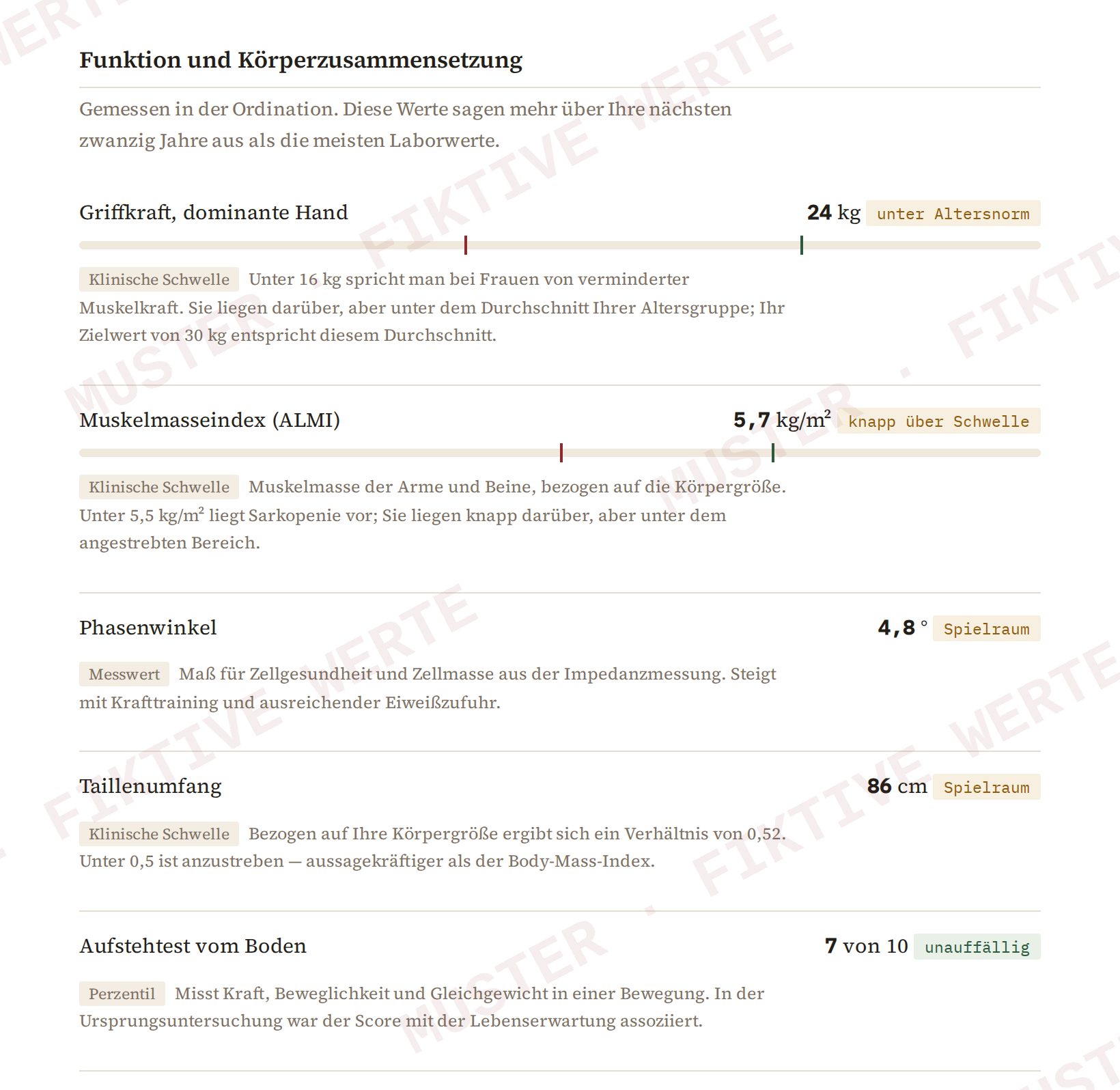
Excerpts from a sample report (in German) with fictitious values. Click to enlarge (opens in new window).
Frequently asked questions
Before your check-up
Basic check-up or health check: which suits me?
The basic check-up is suited to regular monitoring if you feel well and have no particular risks. I recommend the health check if you would like a thorough assessment of where you stand, for instance from the age of 40, with cardiovascular disease in the family, or before a new stage of life. If in doubt, the basic check-up is a good place to start; it can be extended at any time.
How often should I have a check-up?
That depends on your age, medical history and findings. If everything is in order, an interval of one to two years is often sufficient. If we are working on something, such as glucose metabolism or blood lipids, we check sooner.
Do I need to come fasting?
For the blood test, yes: for the basic check-up that is the appointment itself, for the health check the appointment one week beforehand. Please do not eat anything after midnight. Water and unsweetened tea are permitted; take your medication as usual unless we have agreed otherwise.
Is a colonoscopy included?
No, it is a separate examination at the Goldenes Kreuz private hospital. During the check-up, we discuss whether and when it would be advisable for you, and I then perform it myself.
Will my health insurer pay for this?
I am a private physician: you receive an invoice, which you can submit to your insurer, and they will reimburse part of it. Where there is a medical indication, laboratory costs are generally covered by your insurer. The free preventive check-up offered by the Austrian social insurance is, of course, also available; my check-up is considerably more comprehensive and allows more time for consultation.
Who is the check-up intended for?
For women and men who want to know where they stand in terms of their health and wish to take targeted action. Especially when you feel well.
Appointment
Make an appointment
Book your check-up directly online or give us a call.
Already a patient? Requests, questions about results and prescriptions are best sent via Mein Arzt Online (opens in new window). Opening hours and directions